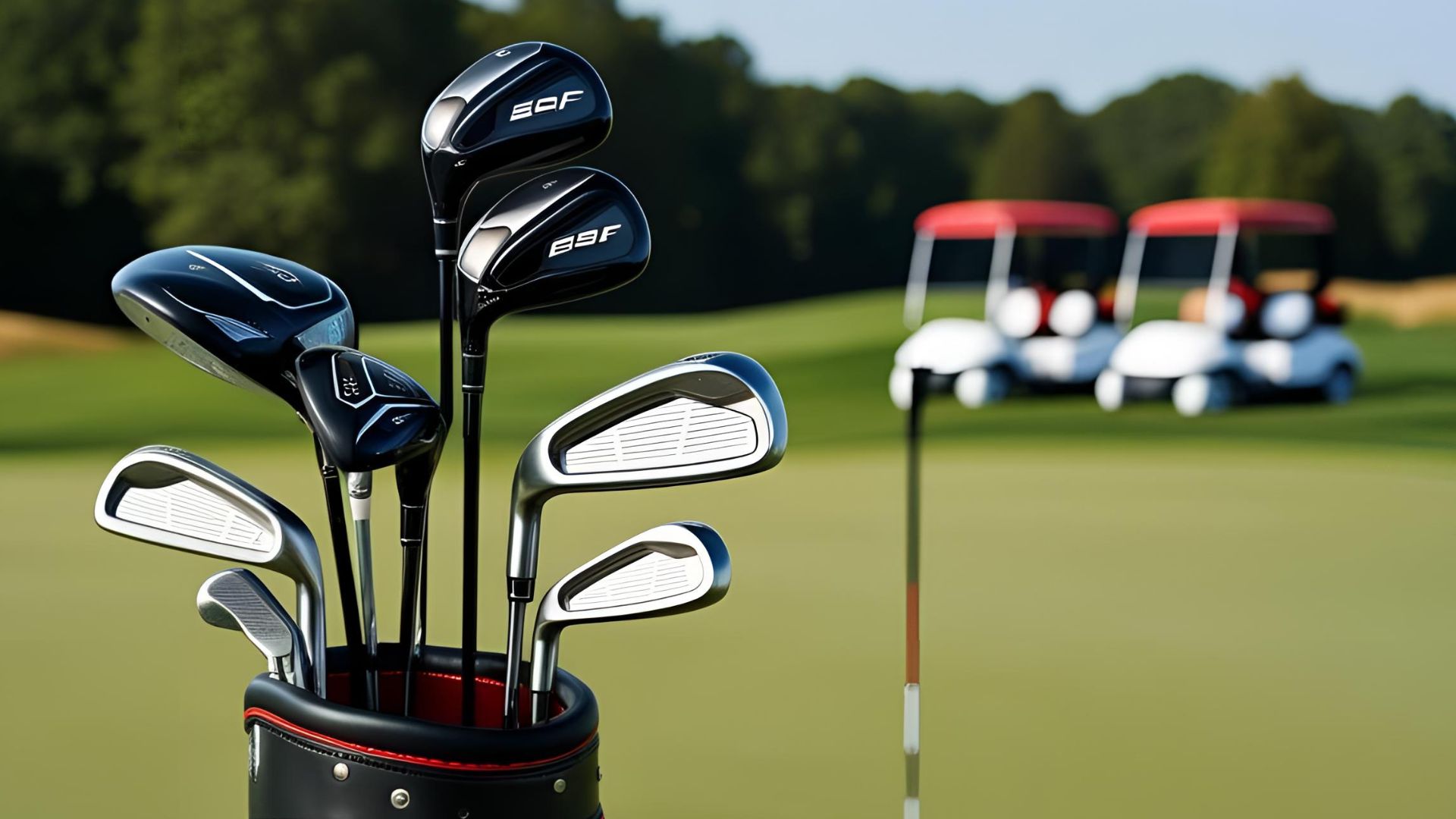
Choosing the right golf clubs for mid handicappers can make a noticeable difference in consistency, confidence, and scoring. Mid-handicap golfers usually strike the ball well enough to benefit from added control. However, they still need forgiveness when contact is less than perfect.
That balance makes club selection especially important.
Highly forgiving beginner clubs may limit feel and shot-making potential. On the other hand, demanding players’ clubs can punish small mistakes. Therefore, the ideal equipment sits somewhere between those two extremes.
Modern golf equipment gives mid-handicap players plenty of options. Drivers offer adjustable settings and larger sweet spots. Irons combine compact shapes with hidden forgiveness. Hybrids make difficult long-iron shots easier, while modern wedges provide impressive control.
However, buying new clubs based only on appearance or brand reputation can lead to expensive mistakes.
Before you upgrade, consider your swing speed, typical misses, preferred ball flight, distance gaps, and short-game needs. This guide explains what to look for throughout your bag so you can make a smarter buying decision.
What Is Considered a Mid Handicap in Golf?
A mid-handicap golfer usually falls somewhere between a low single-digit player and a higher-handicap recreational golfer. There is no universal cutoff, although handicaps around 10 to 20 are commonly considered mid range.
Players in this category often have reasonably repeatable swings. They may hit excellent shots throughout a round, but occasional mistakes still create larger numbers.
Because of that, golf clubs for mid handicappers should provide assistance without removing feedback completely.
A mid-handicap golfer may need help maintaining ball speed on off-center strikes. At the same time, that player might want enough workability to shape shots or control trajectory.
Your handicap alone should not determine your equipment, though.
Two players with identical handicaps can have very different swings. One may struggle with driver accuracy, while another loses strokes around the green. One golfer may generate high speed, while another depends on accuracy and course management.
Therefore, consider your specific strengths and weaknesses before changing equipment.
Forgiveness Should Still Be a Priority
Many improving golfers believe they should move into demanding clubs as soon as their handicap drops. However, forgiveness remains valuable at nearly every skill level.
Even professionals miss the center of the clubface.
The best golf clubs for mid handicappers protect ball speed when contact moves toward the heel or toe. This means mishits can still travel reasonable distances instead of falling dramatically short.
Look for clubs with larger effective hitting areas and stable designs. Perimeter weighting can increase resistance to twisting on off-center strikes.
In irons, cavity-back construction usually provides more forgiveness than traditional muscle-back blades. Manufacturers can move weight around the clubhead to improve stability without making the club appear oversized.
Drivers with high moment of inertia can also help reduce distance loss and directional variation.
However, maximum forgiveness is not always necessary.
Some mid-handicap players prefer slightly smaller clubheads because they provide better feedback and cleaner turf interaction. Therefore, the goal is finding enough forgiveness for your normal misses without sacrificing the characteristics you value.
Choose the Right Driver
The driver can influence both scoring opportunities and confidence. A well-fitted model can produce more usable distance while keeping your misses manageable.
When comparing golf clubs for mid handicappers, pay close attention to driver forgiveness rather than chasing maximum ball speed alone.
A larger, stable clubhead can maintain speed when contact moves away from the center. Meanwhile, adjustable weighting may help you influence launch or shot shape.
Loft is equally important. Too little loft can produce low drives that struggle to stay airborne. Conversely, excessive loft can create a trajectory that climbs too high.
Your ideal loft depends on clubhead speed, angle of attack, spin, and launch conditions.
Shaft selection also deserves attention. Flex, weight, torque, and overall profile can influence how the club feels and performs.
Rather than assuming a particular flex is correct based solely on swing speed, test several combinations. A professional fitting can identify which setup delivers the best balance of distance and dispersion.
Look for the Right Iron Design
Irons may be the most important part of a mid-handicapper’s equipment decision. They need to provide dependable distance while offering enough precision for approach shots.
Many golf clubs for mid handicappers use players-distance or game-improvement iron designs.
Players-distance irons often combine a compact appearance with modern technology hidden inside the head. They may feature hollow construction, thin faces, or strategic weighting.
Game-improvement irons generally have larger heads and more visible perimeter weighting. They prioritize forgiveness and easy launch.
Neither category is automatically better.
If you strike your irons consistently but want help maintaining distance, a players-distance design could work well. If contact varies significantly, a forgiving cavity-back model may provide better results.
Sole width matters too. Wider soles can help prevent excessive digging, while narrower soles may suit players who prefer cleaner turf interaction.
The ideal iron should inspire confidence at address while producing predictable results from your normal strike pattern.
Do Not Ignore Shaft Selection
Golfers often focus heavily on clubheads while overlooking shafts. Yet the shaft influences weight, feel, timing, launch, and overall performance.
When choosing golf clubs for mid handicappers, consider both steel and graphite options.
Steel remains common in irons because it provides stability and consistent feedback. However, modern graphite shafts have improved significantly. They are available in many weights and profiles.
Graphite can reduce overall club weight and may feel more comfortable for golfers seeking additional speed. It can also reduce vibration at impact.
Weight may matter just as much as flex.
A shaft that is too heavy can make the club difficult to swing consistently. Meanwhile, an extremely light shaft may make it harder for some golfers to feel the club throughout the swing.
Testing different weights is therefore important.
Your preferred trajectory should also influence shaft selection. Certain profiles may promote higher or lower launch characteristics, although the golfer’s delivery remains the biggest factor.
Consider Hybrids Instead of Long Irons
Long irons can be difficult to hit consistently because they combine lower loft with longer shafts. Fortunately, hybrids offer an easier alternative.
Many sets of golf clubs for mid handicappers become more playable when difficult 3-irons, 4-irons, or even 5-irons are replaced with hybrids.
A hybrid usually has a wider sole and deeper center of gravity than a traditional long iron. As a result, it can launch the ball higher while providing additional forgiveness.
Hybrids can also perform well from rough. Their head design often moves through longer grass more effectively than a long iron.
However, some golfers prefer fairway woods or utility irons.
Fairway woods may produce higher flight and additional carry. Utility irons, meanwhile, can provide a more penetrating trajectory for confident ball strikers.
The best choice depends on your distance gaps.
Instead of deciding based on club numbers, determine how far each option actually travels. Your set should provide useful yardage separation from one club to the next.
Build a Smart Wedge Setup
Wedges are scoring clubs, so your setup deserves careful consideration.
The best golf clubs for mid handicappers should include wedges that create consistent distance gaps. Large yardage gaps can make partial shots unnecessarily difficult.
Start by identifying the loft of your pitching wedge. Modern iron sets sometimes feature stronger lofts, which can create a significant gap between the pitching wedge and traditional sand wedge.
For example, you may need a gap wedge to create smoother distance progression.
Bounce is another important factor.
Higher-bounce wedges can work well for golfers with steeper swings or those who play on softer turf. Lower-bounce options may suit shallow swings and firm conditions.
Grind affects how the sole interacts with the ground. Different grinds can make it easier to open the face, play bunker shots, or strike full approaches.
Rather than carrying several wedges with overlapping distances, build your setup around the shots you actually encounter.
Do You Need a More Forgiving Putter?
Putting accounts for a significant portion of your strokes, yet golfers sometimes spend far more time choosing drivers and irons.
A putter should match your stroke and visual preferences.
When building golf clubs for mid handicappers, consider whether a blade or mallet putter gives you greater confidence.
Mallet putters often provide higher stability on off-center strikes. Their larger heads can also accommodate prominent alignment systems.
Traditional blades offer a compact appearance and may provide more feedback. Some golfers simply aim them more naturally.
Toe hang and face balance can also influence how a putter works with your stroke.
However, there is no universal putter style for a particular handicap.
Test different designs from realistic putting distances. Pay attention to starting direction, speed control, and confidence rather than choosing based solely on appearance.
A properly fitted putter can potentially save more strokes than an expensive driver upgrade.
Distance Is Important, but Consistency Matters More
Modern golf equipment frequently promotes distance. Extra yards are certainly useful, but they should not come at the expense of predictable performance.
When evaluating golf clubs for mid handicappers, compare average results instead of focusing on your longest shot.
For example, one iron might occasionally travel farther but produce inconsistent distances. Another may be slightly shorter yet deliver tighter dispersion.
The second option could be far more useful on the course.
The same principle applies to drivers. A few additional yards provide little benefit if your misses regularly finish in hazards or deep rough.
Consistency becomes increasingly important as your handicap improves.
You need to know how far each club travels on a normal strike. Reliable yardages make club selection easier and can improve course management.
Therefore, evaluate carry distance, dispersion, trajectory, and mishit performance together.
Should Mid Handicappers Get Custom Fitted?
A professional fitting can be valuable for golfers who are ready to invest in new equipment.
Custom fitting allows you to compare golf clubs for mid handicappers under controlled conditions. Launch-monitor data can reveal differences that are difficult to identify by feel alone.
A fitter may examine clubhead speed, ball speed, launch angle, spin, carry distance, and dispersion.
Iron fittings can also evaluate lie angle, shaft length, shaft weight, and overall club configuration.
However, fitting is not only about maximizing distance.
A strong fitting should improve consistency and help you understand why a particular setup works. The longest option is not always the best recommendation.
Be honest about your normal swing during a fitting. Trying to swing unusually hard can produce numbers that do not represent your on-course game.
Whenever possible, compare several brands and models. An open-minded approach can lead to surprising results.
Set Makeup Matters More Than Matching Clubs
Your golf bag does not need to contain a perfectly matching set.
Instead, each club should perform a specific role.
The ideal golf clubs for mid handicappers might include a forgiving driver, a high-launch fairway wood, two hybrids, players-distance irons, and specialized wedges.
Another golfer might prefer a driver, several fairway woods, cavity-back irons, and fewer wedges.
Both setups can work.
Start by identifying distance gaps. If two clubs travel almost the same yardage, carrying both may waste valuable space.
Likewise, consider which shots create the most difficulty.
If your 4-iron rarely produces good results, replacing it with a hybrid could make sense. If you struggle with long fairway shots, an additional fairway wood may help.
Build your bag around real performance rather than traditional expectations.
Common Buying Mistakes to Avoid
Buying new equipment can be exciting, which makes it easy to prioritize appearance or marketing over performance.
One mistake is choosing golf clubs for mid handicappers based entirely on handicap recommendations. Your swing characteristics matter more than a number on your scorecard.
Another mistake is purchasing overly demanding irons because they look better at address. Compact blades can be beautiful, but they provide limited help on mishits.
Do not assume stronger lofts automatically mean better irons either. Distance only matters when trajectory and stopping power remain useful.
Shafts should not be ignored. An excellent clubhead paired with an unsuitable shaft can deliver disappointing results.
Additionally, avoid replacing your entire bag simply because newer models become available.
If a club performs consistently and inspires confidence, there may be little reason to remove it.
Spend money where improvement is most likely.
How to Test Clubs Before Buying
Testing equipment before purchasing can prevent expensive mistakes.
Begin with your current clubs. Establish baseline numbers for carry distance, ball speed, launch, spin, and dispersion.
Then compare potential golf clubs for mid handicappers against those numbers.
Hit enough shots to create a meaningful sample. One perfect strike should not determine your decision.
Pay particular attention to mishits. A new club should ideally improve your average performance, not simply produce impressive results from perfect contact.
If possible, test from grass as well as mats. Turf interaction can significantly influence how irons and wedges feel.
Outdoor testing also allows you to observe actual ball flight.
Finally, consider confidence. Numbers matter, but you also need to enjoy looking at the club and feel comfortable using it under pressure.
When Should You Upgrade Your Golf Clubs?
You do not need new equipment every year.
Modern clubs can remain competitive for many seasons, especially when properly maintained.
Consider upgrading when your existing equipment no longer suits your swing. For example, significant changes in speed or technique may make your current specifications less suitable.
You might also consider new golf clubs for mid handicappers when certain areas of your bag consistently create problems.
Perhaps your long irons are difficult to launch. Maybe your driver produces excessive spin. Alternatively, your wedge lofts may leave awkward distance gaps.
Wear can also justify replacement. Wedge grooves gradually lose effectiveness, particularly when the clubs receive frequent use.
However, equipment should solve identifiable problems.
Before buying, determine exactly what you want the new club to improve. That approach makes it easier to judge whether an upgrade actually provides value.
Conclusion: Choose Clubs That Help Your Misses
Mid-handicap golfers occupy an interesting position. They have enough skill to appreciate feel, trajectory, and control, yet they still benefit significantly from forgiveness.
The best golf clubs for mid handicappers provide that balance.
Look for a forgiving driver that produces reliable launch and manageable spin. Choose irons that protect ball speed without sacrificing the appearance and feedback you prefer.
Consider hybrids when long irons become inconsistent. Meanwhile, build your wedge setup around useful distance gaps and your typical playing conditions.
Most importantly, buy equipment for the golfer you are today.
Do not choose demanding clubs simply because you hope to grow into them. Likewise, do not assume you need maximum game-improvement technology because your handicap sits within a particular range.
Test different options, compare average performance, and consider professional fitting when possible.
The right equipment will not replace practice. However, it can make your good swings more rewarding and your imperfect swings less costly.
FAQ
1. What type of irons are best for a mid-handicap golfer?
Players-distance and game-improvement irons are both strong options. The right choice depends on strike consistency, preferred appearance, trajectory, and the amount of forgiveness required.
2. Should a mid-handicap golfer use blades?
Some skilled mid-handicap players can use blades successfully. However, cavity-back or players-distance irons usually provide more forgiveness without giving up much control.
3. Are hybrids better than long irons?
Hybrids are generally easier to launch and more forgiving. Still, confident ball strikers may prefer the trajectory and appearance of long or utility irons.
4. How many wedges should a mid-handicap golfer carry?
There is no perfect number. Instead, choose wedges that create consistent yardage gaps and provide the versatility required for your typical short-game shots.
5. Is custom fitting worth it for mid-handicap golfers?
Yes, it can be. A fitting can help identify suitable clubheads, shafts, lofts, lie angles, and set configurations based on actual swing and launch data.